

Domestic agrochemical demand fell 19.3% in 2023-24. Channel inventory piled up 15-20% across the sector. UPL’s revenue fell ₹3,892 crore in a single year.
That was a strong El Nino, not a Super one.
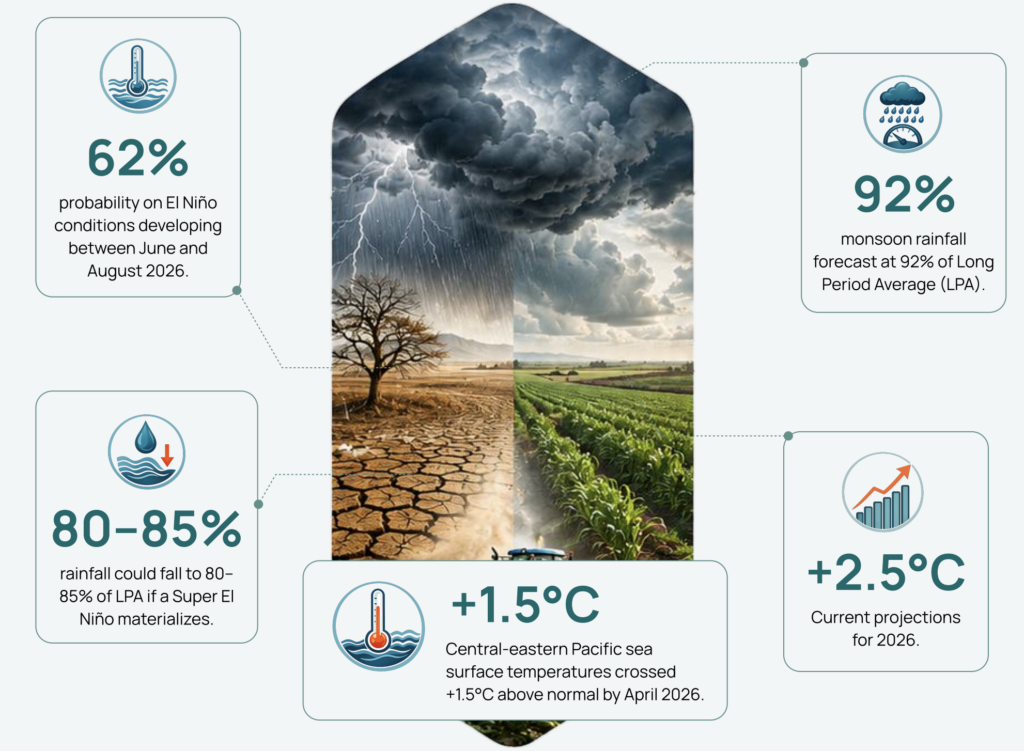
The 2026 event is tracking more intense. Pacific sea surface temperatures crossed +1.5°C above normal by April 2026, a pace that preceded every Super El Nino on record. Current projections have 2026 exceeding +2.5°C. For India’s agrochemical market, this means a multi-season demand contraction, not a one-year blip.
How does El Nino affect fertiliser and agrochemical demand in India?
El Nino reduces and delays monsoon rainfall, which directly compresses the sowing window. A delayed sowing season shortens the crop protection cycle: fewer spray windows for pesticides, fungicides, and herbicides. Farmers who haven’t planted don’t buy inputs.
In a Super El Nino year, the compression runs deeper. Farmers in affected regions shift crop mix, moving from water-intensive rice and cotton toward drought-tolerant millets and pulses. Products positioned for rice or cotton see sharply reduced demand, while the shift to alternate crops happens faster than dealer feedback can capture.
The India Meteorological Department has forecast 2026 monsoon rainfall at 92% of Long Period Average. If Super El Nino thresholds materialise (rainfall falling to 80-85% of LPA), agrochemical revenue declines of 15-30% are projected for companies without real-time sowing visibility.
What happened to agrochemical sales in 2023-24?
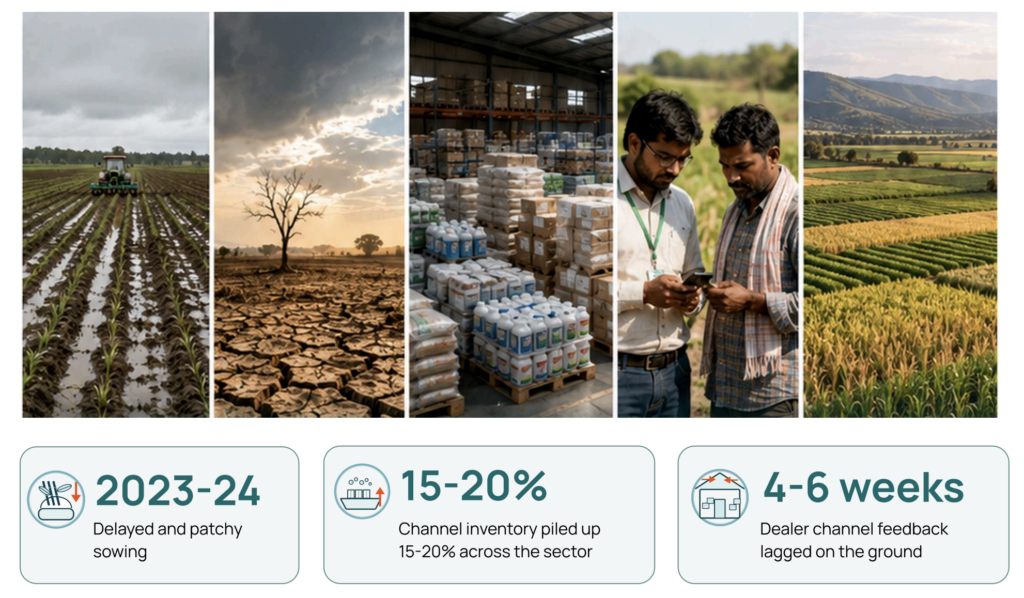
India’s agrochemical market, worth approximately USD 8.2 billion, saw domestic demand fall 19.3% in 2023-24 as the El Nino-driven delayed sowing compressed the spray window across major kharif-growing states.
Channel inventory rose 15-20% as dealers, uncertain of sowing progress, held back orders. By the time companies had clarity on which districts had failed and which had partial crop, the window for redistribution had closed.
UPL, one of India’s largest agrochemical companies, reported a revenue decline of ₹3,892 crore. Across the top five companies, an estimated ₹500-1,000 crore of working capital was locked in wrong-geography inventory.
A Super El Nino in 2026 adds a dimension that 2023-24 didn’t have: multi-season impact. Reduced reservoir levels carry into rabi, and the following kharif starts with depleted soil moisture. Demand doesn’t recover in one season.
Why does inventory end up in the wrong place during a drought year?
Inventory allocation decisions are made before the season, using prior-year territory patterns. When monsoon performance shifts those patterns (and it always does in El Nino years), inventory is already in transit or warehoused in regions where crops have failed.
In 2023-24, fungicide inventory sat unsold in drought-hit districts while herbicide demand spiked in areas with late sowing. By the time the mismatch was visible through dealer returns, the season was over.
The underlying problem is a 4-6 week lag between what’s happening in the field and what dealer channel feedback reports upward. Satellite-derived sowing progression maps close that lag. Village-level crop-type classification updated weekly tells companies which districts have shifted from rice to millets before dealer orders reflect the change.
How should agri-input companies prepare for El Nino 2026?

Four specific risks need planning:
Demand forecasting. Historical sales data and dealer feedback lag ground reality by 4-6 weeks in a normal year and longer in drought years. Companies with satellite-derived sowing maps and vegetation health indices get 4-6 weeks of advance visibility into actual demand.
Inventory positioning. District-level crop health dashboards showing active crop growth versus crop failure allow redistribution 3-4 weeks before traditional signals arrive. Estimated reduction in dead stock: 10-15%.
Field deployment. Sowing completion maps at village and block level show where high-opportunity pockets have formed and where sowing has failed. Field teams can be redeployed within days, not quarters. Estimated improvement in visit productivity: 20-30%.
Product mix. Real-time crop-mix transition maps show the acreage shift from rice to millets, cotton to pulses, in real time. R&D and launch teams can adjust positioning before the season rather than post-mortem.
Companies that had real-time sowing intelligence in 2023-24 avoided the worst of the inventory pile-up. In a Super El Nino year, the gap between those with early visibility and those without will be larger.
Get the full picture. SatSure’s Super El Nino 2026 report covers the agri-input sector in detail: the specific pain points, quantified impacts, and how satellite intelligence at village level changes demand planning in a crisis year.