

By Vishal Thiruvedula, VP- Product at SatSure
In our second Kharif 2026 sowing report, we argued that rainfall was the primary constraint delaying sowing, a direct outcome of El Niño. The National Oceanic and Atmospheric Administration (NOAA) estimates a 63% chance of a very strong El Niño developing later this year, with peak intensity forecast between September and November. Early signs of its influence are already visible in India, as uneven monsoon rainfall has impacted Kharif sowing progress.
The Kharif 2026 season is unfolding differently from 2025. Uneven rainfall has altered sowing patterns, leaving coverage across the 20 monitored states 35% behind last year. Bihar showed an increase in sowing area from 3.65 lakh hectares on 11 July to 9.77 lakh hectares on 21 July, a 168% increase, the fastest among all states, supported by favourable rainfall.
Gujarat, however, breaks the pattern. Despite recording a 204.2% rainfall surplus, the highest positive anomaly in the country, it has achieved only 18.9% of its five-year normal sowing area and remains 68.0% behind last year for the same date.
These two cases show a complex picture. Rainfall is not the only binding constraint for sowing. Other structural and operational bottlenecks appear to be delaying sowing despite favourable weather. In this article, we examine what those constraints are and how they will impact the upcoming weeks of Kharif.
The Story So Far: Fast Growth, Slow Recovery
The area sown for 20 major states has tripled, from 98 lakh Ha on 21st June to 307 lakh Ha on 21st July. While the growth has been fast, the overall sown area numbers still lag by 35% compared to 2025 Kharif.
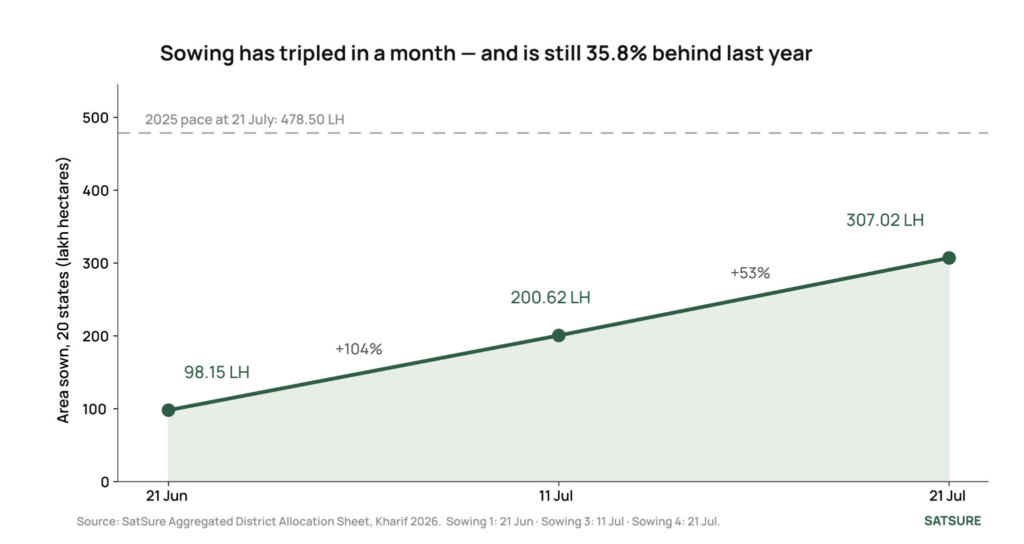
Kharif 2026: Third Sowing Analysis in Short
In our sowing estimates, we cover four areas that impact any agricultural season’s performance: Sowing, Rainfall, Water reservoir replenishment and climate hazards.
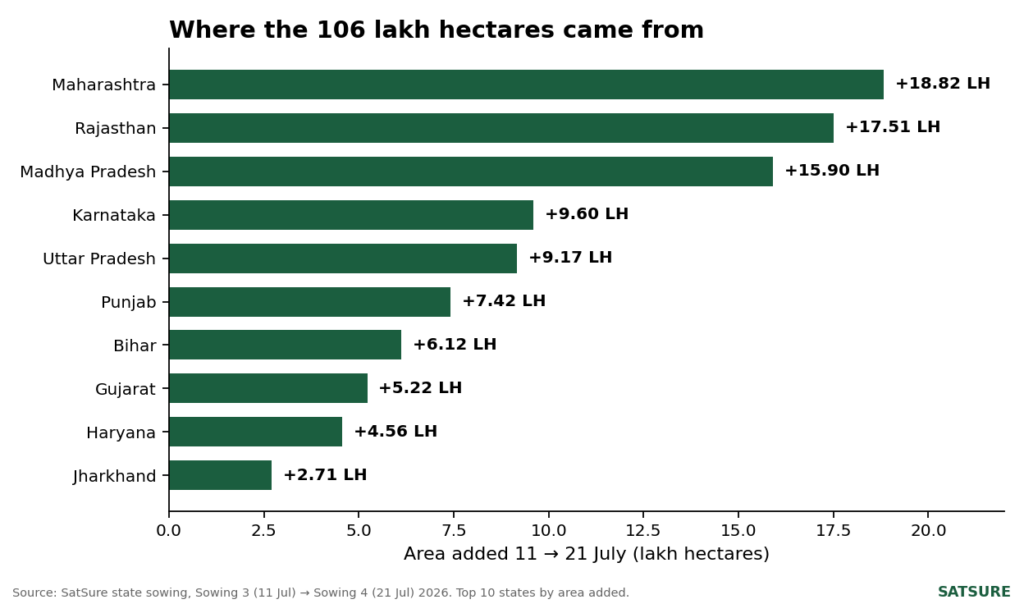
Rapid Growth in Area sown
- The overall sown area grew from 200.62 to 307.02 lakh hectares, up 53% in ten days, for the 20 states we are monitoring.
- Even with this growth, the current season lags by 35.8% compared to 2025.
- Bihar went from 9.7% to 25.8% of its normal area, the largest proportional gain of the season.
- States under 20% of normal rose from three to four.
Narrowing Rainfall Deficit
- The cumulative deficit since 1 June narrowed from −17.7% to −13.7%.
- Week 4 (Jul 22nd – Jul 28th) closed at +5.2% above normal, the second surplus week since early July, after a mid-July shortfall of −15.6%.
- Dry districts have increased. Deficient and scanty regions went from 57% to 61% of the country, during the surplus week.
Looming El Niño
- Reservoir storage climbed from 34.5% to 44.4% of capacity across the 166 CWC reservoirs, adding 18.23 BCM in a fortnight.
- Against last year, storage improved from roughly 61% to 65.4%
- The National Oceanic and Atmospheric Administration (NOAA) estimates a 63% probability of a very strong El Niño developing, with peak intensity expected between September and November
Overall, for this kharif season, sowing has been delayed, rainfall deficits have narrowed and reservoirs are replenishing. However, the recovery remains uneven. While the averages at national level show improvements, the sowing area still lags compared to previous year.
More Rainfall Isn’t Translating into More Sowing
According to our second estimate, rainfed states were still waiting for rainfall. The latest data paints a more complex picture: Maharashtra recorded a 45.6% rainfall surplus and grew sowing by 150% (12.13 to 30.95 lakh hectares), while Madhya Pradesh grew 123% despite a 25.5% rainfall deficit. In contrast, Gujarat received a 204.2% rainfall surplus but sowing grew by just 62%, remaining at only 18.9% of normal and 68.0% behind last year, while Chhattisgarh grew only 5% on normal rainfall and Odisha grew by just 26% despite a 120.5% rainfall surplus, remaining the lowest-coverage state in our analysis.
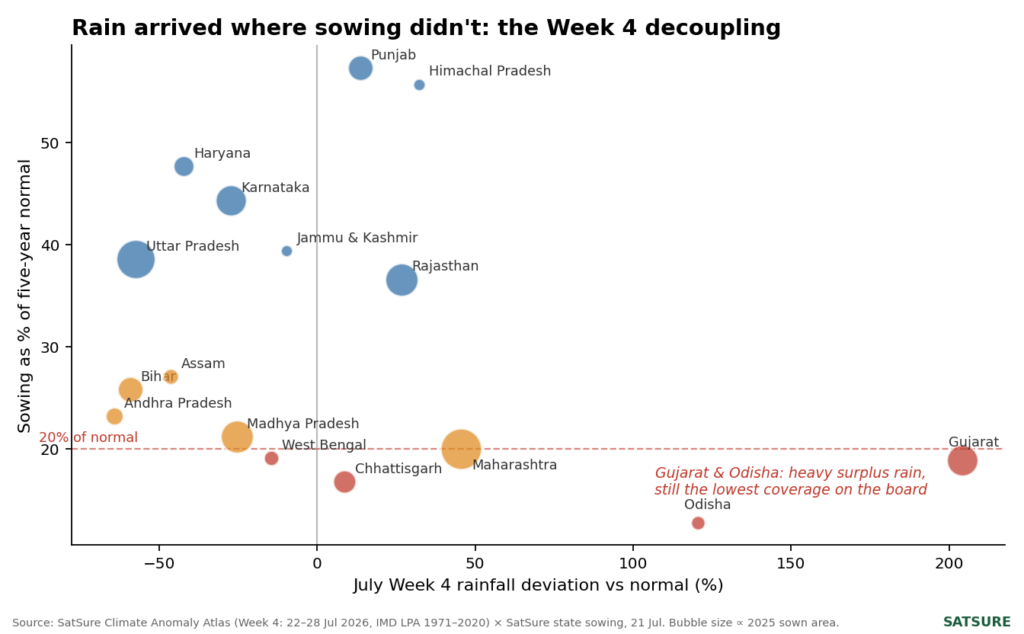
When sowing fails to respond to rainfall, multiple constraints may be at play. Limited access to seeds, inputs, credit, labour, machinery, or even excessive rainfall over a short period can all delay sowing. Sowing is a direct function of soil moisture, not rainfall alone. In Gujarat, for example, cotton and groundnut require a workable seedbed, and a 204% rainfall surplus following a dry June is just as likely to waterlog fields as it is to improve soil moisture.
Like Gujarat, Chhattisgarh, and Odisha with good rainfall in a week, have shown low growth in sown area. The numbers are even more alarming, with the three states contributing to 26.71 lakh hectares against a normal of nearly 130 lakh hectares.
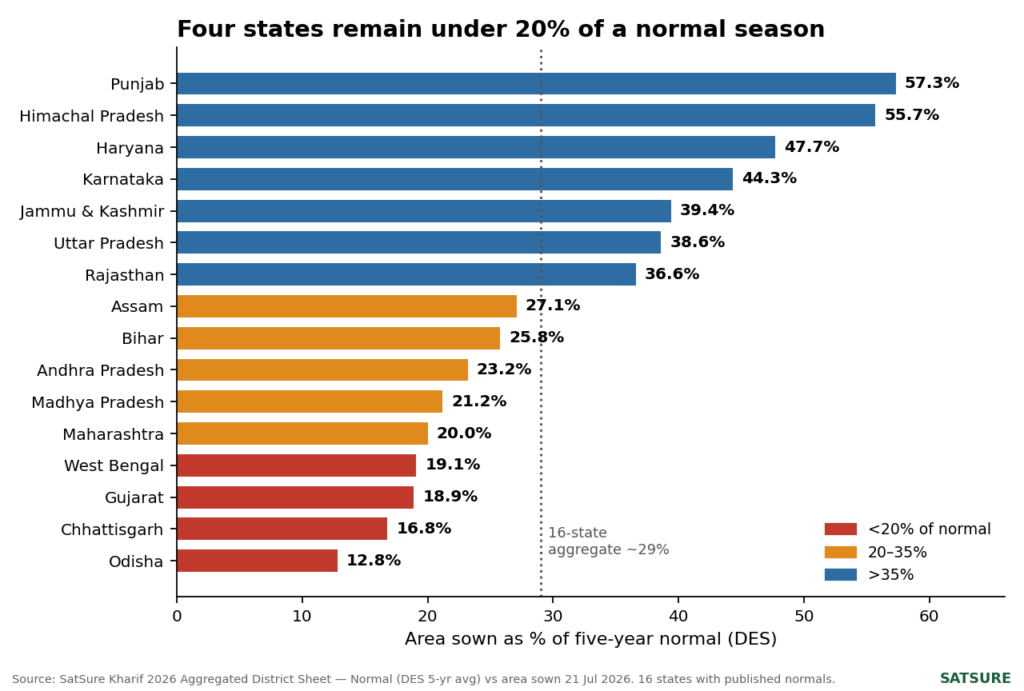
The chart above shows, out of the 16 major Kharif states, 9 states have an area sown under 30% and 5 states under 20% against the five year normal.
A stark contrast is clearly visible amongst the states. States which have good irrigation have performed well compared to rainfed states. Punjab, Haryana and Uttar Pradesh occupy three of the top five positions. Haryana and Uttar Pradesh did so with deficient rainfalls of −42.3% and −57.4% respectively.
For Bihar, the case might be different, with recovery triggered by the early-July rainfall spell, not by the rainfall received during the latest reporting week. The state grew from 9.7% to 25.8% of normal despite a 59.1% rainfall deficit in the latest period because paddy transplanting might have continued.
The data offers a good opportunity to act and intervene. With the sowing window still open, rapid intervention on operational bottlenecks like seed dispatches, input inventories and credit disbursements can still improve the sowing numbers in upcoming weeks.
Uneven Rainfall Is Widening the Sowing Gap
Although India’s cumulative rainfall deficit narrowed from −17.7% to −13.7%, the improvement masks a growing imbalance in rainfall distribution. More districts shifted toward the extremes, deficient districts rose from 22% to 32%, excess districts edged up from 22% to 23%, and normal districts fell from 21% to 16%, making rainfall increasingly uneven.
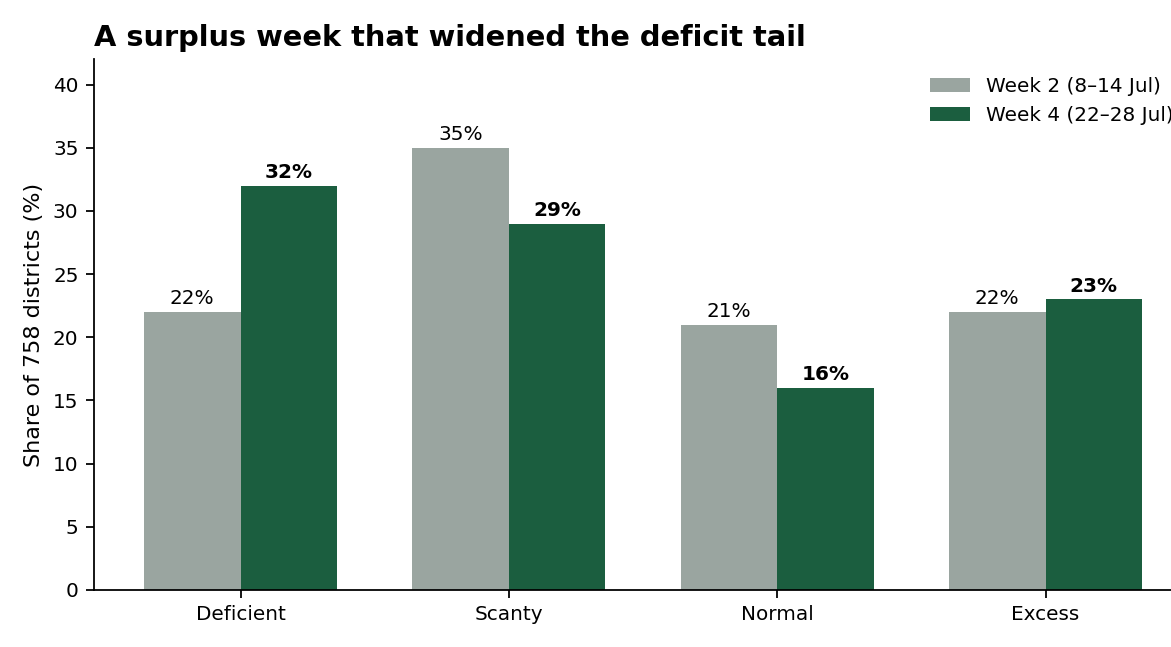
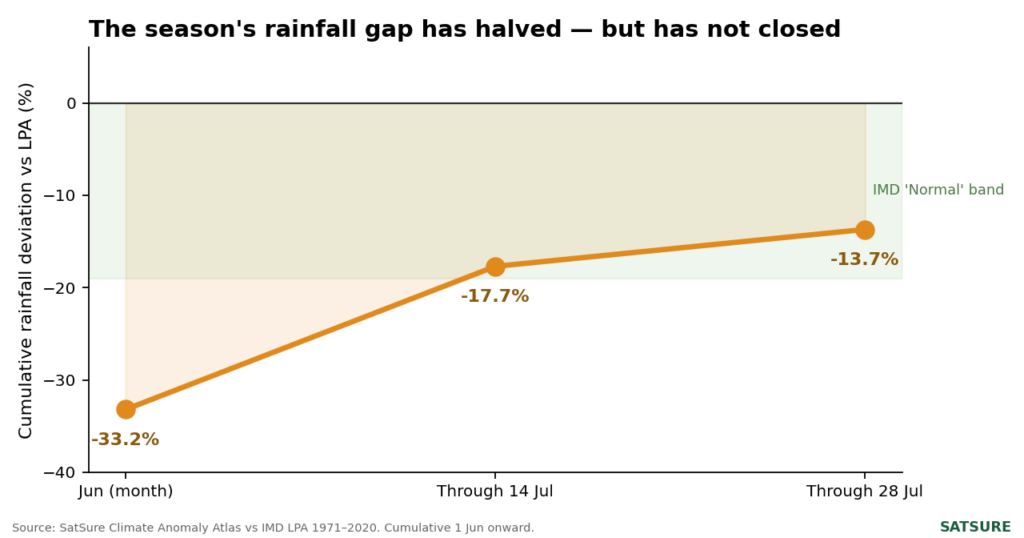
While the country recorded a 5.2% rainfall surplus in Week 4 (July 22nd -28th), the share of dry districts has increased, meaning rainfall is becoming increasingly concentrated instead of evenly distributed. For a season already 35% behind last year’s sowing, so far, the season looks worrisome.
Reservoirs Refills Are Supporting Kharif, but Rabi Needs More Recharge
In our previous estimates, we highlighted that reservoir storage should be read as a Rabi indicator along with Kharif requirements. The latest Central Water Commission numbers align with our estimates.
Reservoir storage for 166 monitored reservoirs recovered sharply over the past fortnight, increasing from 63.249 BCM (34.5% of live capacity) on 16 July to 81.479 BCM (44.39%) on 30 July. The 18.23 BCM refill—compared with just 3.81 BCM in the previous fortnight, signals that reservoir recharge has resumed, reducing the immediate water risk for the ongoing Kharif season.
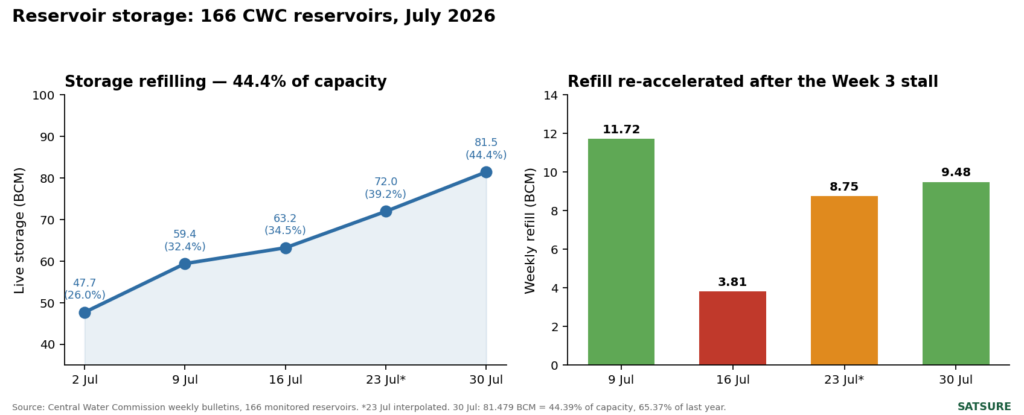
Reservoir storage stands at just 65.37% of the 124.634 BCM recorded on the same date last year, while southern reservoirs are only 33.73% (47 reservoirs) of the capacity and northern reservoirs 41.03% (11 reservoirs) full. Although the immediate risk to Kharif has eased, sustained reservoir recharge through mid-September will be critical to reducing water risk for the upcoming Rabi season.
What does this mean? Reservoir storage is no longer the primary risk for Kharif, but it remains a concern for the upcoming Rabi season. Northern and southern reservoirs are operating from a base roughly one-third below last year, making continued recharge through mid-September critical to closing the gap and securing water availability for winter crops.
The El Niño Risk Is Extending Beyond Kharif
The latest NOAA outlook continues to project El Niño through early spring 2027 but raises the intensity forecast. The Climate Prediction Center now assigns a 63% probability of Niño 3.4 exceeding +2.0°C, NOAA’s threshold for a very strong El Niño, with peak intensity expected during September–November.
This aligns with the IRI’s June data, where 13 of 24 models projected a very strong event, while the India Meteorological Department (IMD) continues to forecast a below-normal monsoon at 90% of the long-period average, with a 60% probability of a deficient season.
The rainfall patterns observed over the past month are consistent with this outlook. Rather than a sustained monsoon, rainfall has become increasingly uneven, with more districts shifting towards deficient or excess rainfall while fewer remain in the normal category. It is expected that September–November peak shifts the primary risk from Kharif sowing to Kharif harvesting and Rabi establishment, making the coming months critical for agricultural planning of 2026.
Crop Outlook For Kharif 2026
Soybean.
Madhya Pradesh and Maharashtra have both expanded sharply yet remain near the bottom of the normal table at 21.2% and 20.0% of the 5- year average sowing. The expansion is real, but it has run past the effective central-belt window, which closes around mid-July.
Soybean is dependent on photosensitivity. Area sown from 18 July onward will establish; but the recovery in these two states will depend on photosensitivity, and delayed sowing might potentially impact the final production. In a country importing close to 60% of its edible oil, how the coming week perform will be important.
Rice.
Bihar’s move to 25.8% of normal is the eastern rainfed belt demonstrates recoverability. However, Odisha at 12.8%, West Bengal at 19.1% and Chhattisgarh at 16.8% within the same corridor have failed to pick up.
The differentiator may not be rainfall since Odisha had the country’s second-largest surplus. What will be interesting to monitor now is how transplanting will continue through August, which will impact the current seasons production.
Cotton.
Maharashtra’s 155% expansion and Gujarat’s 62% both carry cotton, and cotton retains roughly three weeks of window beyond soybean’s.
Telangana, the third leg of the Vidarbha–Telangana belt, remains the weakest at −69.7% year on year and July Week 4 rainfall of −33.5%.
Cotton is the crop with the most genuine recovery room left on the board, and Telangana is where that room is least likely to be used.
Pulses.
Karnataka at 44.3% of normal is the strongest reading among tur-leading states, and while the sown area question there is closing, the yield estimates will be uncertain.
Tur is a 150–180 day crop, and the area sown from here pushes pod-filling into December and January. With a very strong El Niño now forecast to peak in September–November, the temperature and moisture path across that pod-filling window is the variable to watch, and it argues for treating fourth-quarter pulse supply as an open question even where area recovers.
What Can We Expect in the Next Fortnight
Whether the three-state anomaly closes.
If Gujarat, Chhattisgarh and Odisha expand sharply in the first fortnight of August, the delay can be assumed to be logistical and is being corrected.
If they do not, the constraint is structural, and their season is largely set.
Whether the establishment matches the area.
Our analysis so far measures the sown area. With 106 lakh hectares planted inside ten days, vegetation response over the next two to three weeks is the first read on whether that area becomes a crop.
A single adverse fortnight would now reach an unusually large share of the national crop at the same growth stage. Weak greening in the sub-20% states would confirm that the sowing surge was executed into unfavourable seedbeds.
Whether refill holds.
Two consecutive strong refill weeks have taken storage to 44.39% of capacity and 65.37% of last year. A third would substantially de-risk Rabi. A stall would leave the second season exposed to an El Niño peaking precisely across its sowing window.
The first edition of this series proposed monitoring the distribution of sown area and rainfall rather than the averages.
The second highlighted the need to measure against normal, as the sowing slowed down, and the importance of reservoir refills for Rabi’s preparedness.
This article closes on an important note. When surplus rain arrives and the sowing does not progress, the reasons can be agri-input inventory and distribution delays, soil moisture availability and credit access. The next fortnight will give us a clearer picture of what we can expect in both Kharif and Rabi 2026.
Sources
- SatSure Agriculture Data(Kharif 2026)
- SatSure Climate Data, 2026
- Ministry of Agriculture & Farmers Welfare, Crop Area Coverage Report (Kharif 2026)
- Central Water Commission, Weekly Reservoir Storage Bulletin
- NOAA Climate Prediction Center, ENSO Diagnostic Discussion and ENSO Alert System Status
- International Research Institute (IRI) for Climate and Society, IRI/CPC ENSO Prediction Plume
- India Meteorological Department (IMD), Southwest Monsoon Seasonal Rainfall Outlook and Extended Range Forecast