

Written By Prateep Basu, CEO and Co-Founder at SatSure
This article was originally published on Mint, on 22 July 2026, available here.
On Saturday, we witnessed a historic moment as Skyroot Aerospace made a success of the maiden flight of its rocket Vikram-I to become the first Indian private company to demonstrate such capability. While as Indians we rejoice this moment, it is important to note that the commercial success of private-sector space ventures requires demand generation for payloads lifted into orbit : like satellites.
Among various applications of satellites such as communication, navigation, scientific research and imaging, the last of these is the most interesting in my view as the space industry is still looking for use cases beyond watching adversaries. For most of its history, the business of watching the planet from orbit has been told as a story of security. But that tale is outdated.
While the West treated Earth observation as a defence asset, Asia’s two largest credit systems have been proving that it can also be a part of economic statecraft—with India and China doing it in very different ways.
Satellite data has entered the Chinese and the Indian economies through an avenue with interesting prospects: the loan file. What looks like a technical banking upgrade is, on closer inspection, a relatively novel exercise that policymakers everywhere would do well to understand.
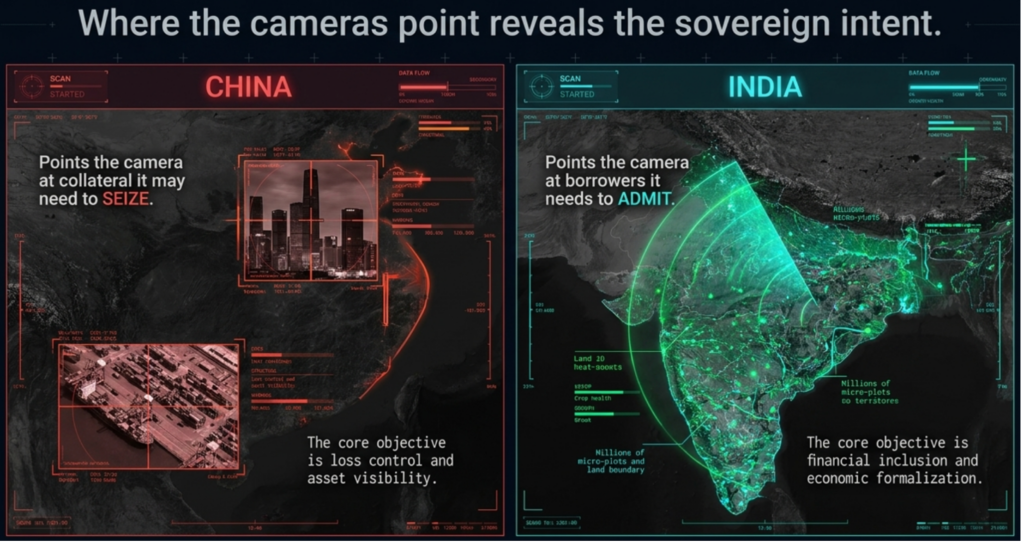
Consider China first. Its banks have begun launching their own satellites. The Postal Savings Bank of China put one into orbit in April; China Merchants Bank and Shanghai Pudong Development Bank did so earlier this year; Ping An Bank began this practice back in 2020. The logic? Watch the collateral against which loans are given. A satellite keeps taking images of a financed construction site by its own schedule, so that it can catch the developer who stages visible work around inspection day and downs tools the moment the credit officer leaves. It tracks the port where cargo behind a trade-finance loan is meant to berth, even as it monitors an animal herd that secures a rural advance.
This capability is formidable and costly. Each bank buys orbital cameras, logged on its balance sheet tens of millions of yuan at a time—and, by the admission of their risk managers, often because rivals are already equipped with satellite data feeds. This is vertical integration of surveillance: capital-heavy, top-down and still in search of proof that it pays off.
India has taken the opposite route. No Indian bank has satellite surveillance; none needs to. Instead, the state has wired the capability into the public infrastructure of credit itself. The instrument is the Unified Lending Interface (ULI), a national credit rail built by the Reserve Bank of India’s innovation arm, born of a 2022 experiment to digitize small farm loans. India’s ULI lets a lender, with the borrower’s consent, pull the information needed to judge a loan— identity, tax records, land titles, etc—through a single digital interface, rather than chase paper across a dozen offices. Crucially, it treats satellite imagery as one of its data pillars, enabling a company like SatSure to integrate its supply smoothly with the lending processes of banks.
In June, the central bank went further. Its new Kisan Credit Card rules made satellite-based crop monitoring a fundable item within a farmer’s own loan limit. India, in other words, put Earth observation into loans, rails and the rulebook. Two countries, the same destination, opposite routes.
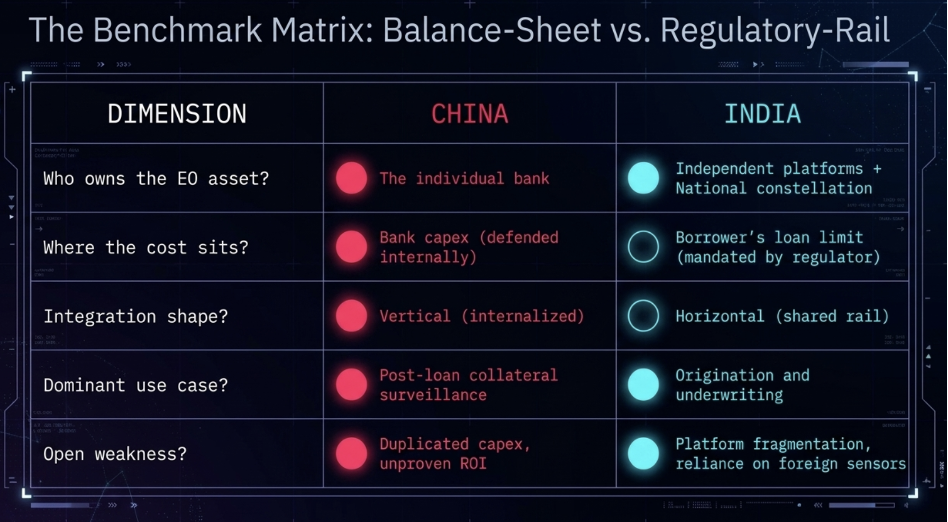
Here is the part neither system advertises. Once satellite data is woven into how a country allocates credit, the distinction between commercial monitoring and economic intelligence dissolves; this is not by intent, but by capability. A network that can see every financed field, port and building site in near-real time can operate as an instrument of national economic intelligence of a kind no defence ministry has ever possessed. And it is being assembled under the gentle banners of risk control and financial inclusion.
This is an inversion that the West’s space narrative misses. The West arrived at satellite power through the situation room and left the credit door comparatively shut: no Western bank launches satellites and no such regulator funds orbital monitoring for credit quality. So it reads Earth observation as a security capability with commercial spillovers. India and China are showing the reverse—an economic capability with security implications nobody has to declare for them to exist. A strategic asset has arrived dressed as a risk score and cost line.
And that is why satellite imaging is such an interesting part of the space sector value chain. It provides a non-linear demand curve for launch-vehicle companies like Skyroot Aerospace that would track the emergence of such use cases.
For Indian policymakers, the following conclusions follow: First, the rail model is well designed and worth defending as national infrastructure. It federates costs, compounds a shared data advantage across lenders and rests on borrower consent under a data-protection statute.
Second, it remains unfinished. The rail effort only closes once India asserts ownership over orbital sensor data, which is why a private constellation now being built by a consortium of Pixxel, SatSure, Dhruvaspace and Piersight under the national space regulator In-Space could be seen as a matter of statecraft, not just enterprise.
Third, there is also the question of who owns the overhead lenses and under what rules. Right now, that contest is being settled in the language of loan limits and launch manifests rather than in any situation room.
This article was originally published on Mint, on 22 July 2026, available here.